
The Ultimate Guide to Prison Visitation: Rules, Dress Codes & Procedures (2026)
Last Updated: January 26, 2026 | Verified by: [DepartmentOfCorrections.org Research Team]
Visiting a loved one in prison is not like visiting someone in the hospital. It is a privilege, not a right, and it is governed by some of the strictest regulations in the United States.
One wrong color shirt, one forgotten ID, or one trace of perfume can result in you being turned away at the gate after driving four hours.
This guide is the internet’s most comprehensive resource on visitation. We have analyzed the handbooks of all 50 State Departments of Corrections to compile this “Master Protocol” to help you get approved, get in, and have a safe visit.
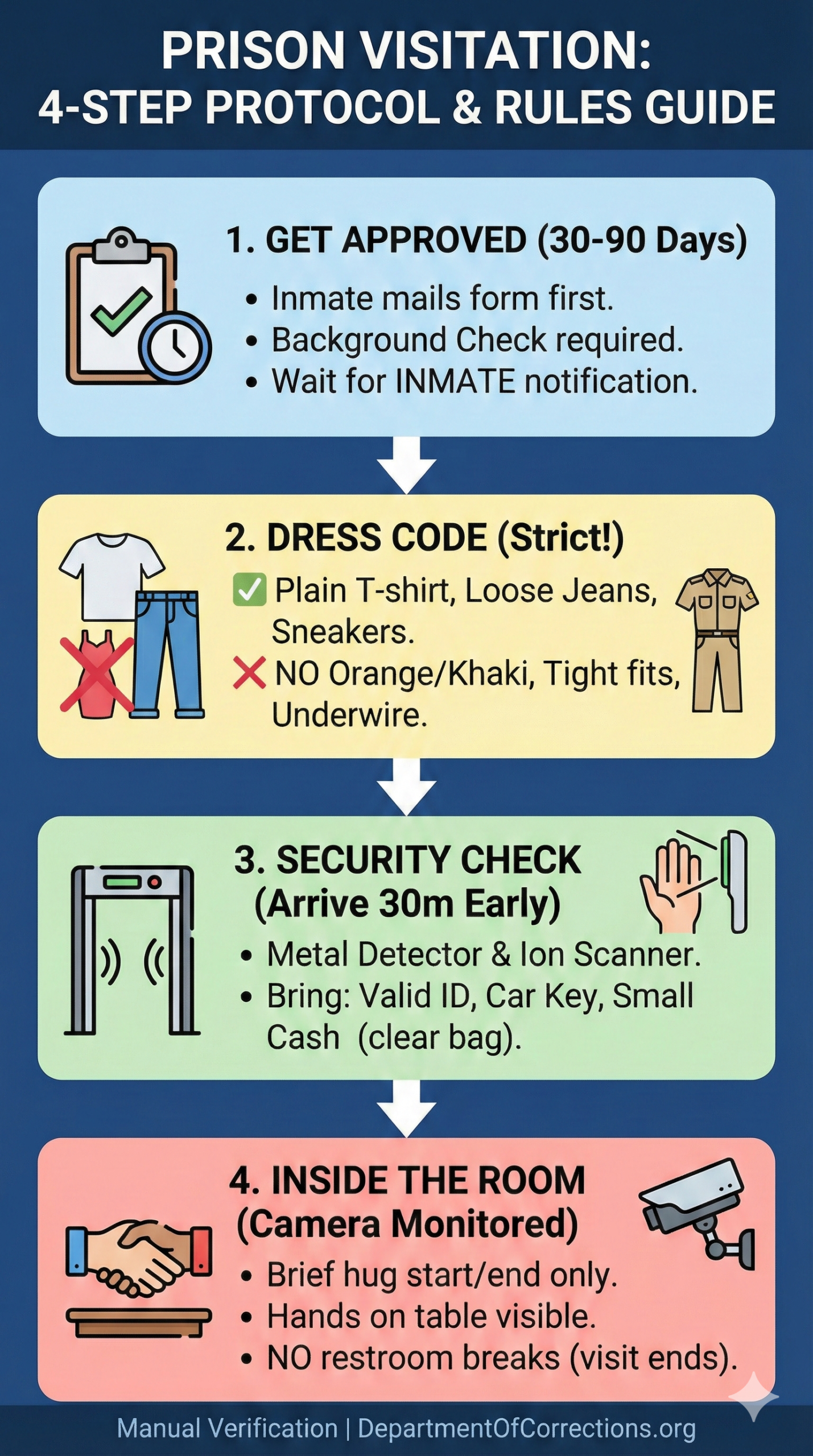
Phase 1: Getting Approved (The Paperwork)
You cannot just “show up.” Before you even think about driving to the facility, you must be on the Approved Visitor List.
1. The Application Form
-
Who initiates it? In 90% of cases (including Federal BOP), the inmate must mail you the blank application form. You usually cannot download it online.
-
The Background Check: You must provide your Driver’s License number, Social Security Number, and criminal history.
-
Honesty is Critical: If you have a past felony, you might still be approved (depending on the state and how long ago it was). However, if you lie about it and they find out, you will be banned for life. Always disclose.
2. The Waiting Game
-
Timeline: Approval typically takes 30 to 90 days.
-
Notification: The prison will not call you. They will notify the inmate. You must wait for your loved one to write or call you to say, “You’re on the list.”
Phase 2: The Dress Code (Strictly Enforced)
This is the #1 reason visits are denied. Prison guards have total discretion. If they decide your outfit is “too tight” or “distracting,” there is no appeal. You leave.
The “Safe” Uniform Strategy
We recommend establishing a “Visitation Uniform” that you wear every time.
-
Top: A plain white or black t-shirt (crew neck, no logos) + a button-down cardigan (to cover shoulders/arms).
-
Bottom: Loose-fitting blue jeans (no rips, no sparkles on pockets).
-
Shoes: Velcro sneakers or slip-ons (makes security faster).
-
Undergarments: Sports bras (no metal underwire).
The “Banned” List
-
Colors: DO NOT wear Orange, Khaki, All-Grey, or Camouflage. These resemble inmate/guard uniforms.
-
Fabric: No sheer (see-through), lace, or spandex/leggings.
-
Fit: If it is “skin tight,” it is banned.
-
Hardware: No underwire bras (they trip metal detectors). No smartwatches.
Pro Tip: Always keep a “backup outfit” (sweatpants and a t-shirt) in your car trunk. If a guard hates your shirt, you can run to the car, change, and save the visit.
Phase 3: Scheduling the Visit
The days of “Walk-In” visits are ending. Most facilities now require online registration.
-
Federal Prisons (BOP): Usually strictly on weekends/holidays.
-
State Prisons: Many use third-party schedulers. You may need to create an account with:
-
GTL (ViaPath): Common for scheduling video and in-person slots.
-
Securus Technologies: Used for many county jails and state prisons.
-
ICSolutions: Used in specific states.
-
The “7-Day Rule”: Most portals open scheduling 7 days in advance. Slots fill up instantly. Log in exactly when the window opens (usually 8:00 AM) to grab your spot.
Phase 4: Arrival & The Security Checkpoint
1. Arrival Time
-
The Window: Arrive 30-45 minutes before your slot.
-
The Lockout: Most facilities stop processing visitors 15-30 minutes after the shift starts. If you are late, you do not get in.
2. The “Ion Scanner” (The Drug Test)
Many prisons randomly swab visitors’ hands or items. This machine detects microscopic particles of narcotics or explosives.
-
False Positives: These are common. Handling cash, pumping gas, or using certain hand lotions can trigger a false positive.
-
Prevention: Wash your hands thoroughly with unscented soap after you park your car but before you walk in. Do not handle money after washing.
-
Result: If you test positive, you will be denied entry for the day. You are usually not arrested unless you have actual drugs on you.
3. What You Can Bring In
-
ID: Valid Driver’s License or Passport (not expired).
-
Car Key: Single key only (no massive keychains).
-
Money: Clear Ziploc bag with quarters/singles (max $20-$50) for vending machines.
-
Baby Supplies: (If applicable) 1 clear bottle, 1 diaper.
Phase 5: Official State Visitation Policies (Direct Links)
Do not guess. Read the official handbook for your specific state below. We have manually verified these links to ensure they go to the official .gov policy pages.
Eastern Region
Central Region
Western Region
(Don’t see your state? Visit our State Directory for the full list of all 50 states.)
Phase 6: Inside the Visitation Room
Once you pass security, you are in a controlled environment. Cameras are watching every move.
Physical Contact Rules
-
The “Hugging Rule”: Most facilities allow one brief hug and kiss at the start and end of the visit.
-
Hand Holding: Usually permitted, but hands must be visible on top of the table at all times.
-
No Lap Sitting: Children over a certain age (usually 5 or 6) cannot sit on the inmate’s lap. Spouses definitely cannot sit on laps.
Food & Vending
-
The Vending Machine: This is often the highlight of the visit. You (the visitor) must buy the items. You cannot give the inmate cash.
-
Opening Items: In many facilities, you must open the chips/soda before you hand it to the inmate (to prevent smuggling).
Restroom Policy
-
For Visitors: If you leave the visitation room to use the bathroom, your visit is terminated. Go before you enter.
-
For Inmates: If the inmate uses the bathroom, they may be strip-searched before returning to the table.
Troubleshooting: “My Visit Was Denied”
If you are turned away, do not argue, scream, or cause a scene. This can get the inmate thrown in solitary (SHU) or get you permanently banned.
Common Reasons for Denial:
-
ID Issues: Your license is expired or cracked.
-
Dress Code: Your skirt was 1 inch too short.
-
Count Time: You arrived during a facility “Count” (when all inmates are counted).
-
Lockdown: The facility went on emergency lockdown an hour before you arrived. (Always call before you drive!)
What to do:
-
Ask the Sergeant politely for the specific reason.
-
Return to your car.
-
If it was a clothing issue, change into your backup outfit and ask to be re-processed (if time allows).